Accessibility, Sort Of

I remember the first time I noticed Brady couldn’t keep up with his usual level of activity. As a little peanut, he was the most active child, up with the sun, barefoot and sticky with popsicle juice by noon. We practically lived outside.
Several years into his health decline, while he was still walking, still eating, still going to school, we went for a family bike ride to the library. There’s a lake behind it where you can watch boats and turtles and maybe grab an ice cream. Brady barely made it there. We stopped halfway home to rest, and he had to lie down afterward. This had never happened before.
A few months later, we traveled to the East Coast to try a new therapy. It showed early promise, like so many before it, and I was good at turning therapy trips into adventures. That trip we found a little family fun park with mini-golf, go-karts, and Brady’s old favorite: a rock wall. As they strapped him into the harness, he hesitated but started to climb. I watched him will his body up the wall, slowly, shakily, but all the way to the top. Once, he’d scrambled up these things like a squirrel. He came down frustrated. It had been so hard. I didn’t know it then, but that would be the last time he would climb a rock wall. Once the full decline began, we never regained what was lost.
We were unwilling, reluctant converts to the disabled community. Brady never saw himself as disabled, even after he lost all movement, speech, and the ability to swallow. I didn’t, either. I saw the same boy inside his body, just more contained. I fervently resisted everything that screamed disability: the wheelchair, the parking placard, homeschooling. Every one of them made our lives infinitely easier and happier once I finally surrendered.
When I accepted the wheelchair, doors that had been closing to us, literally and figuratively, opened again. We could go out without worrying how far he could walk. I got the placard, too, and realized for the first time how impossible it had been to maneuver a wheelchair in a standard parking spaces. It was easier and more comfortable for Brady getting in and out of the car.
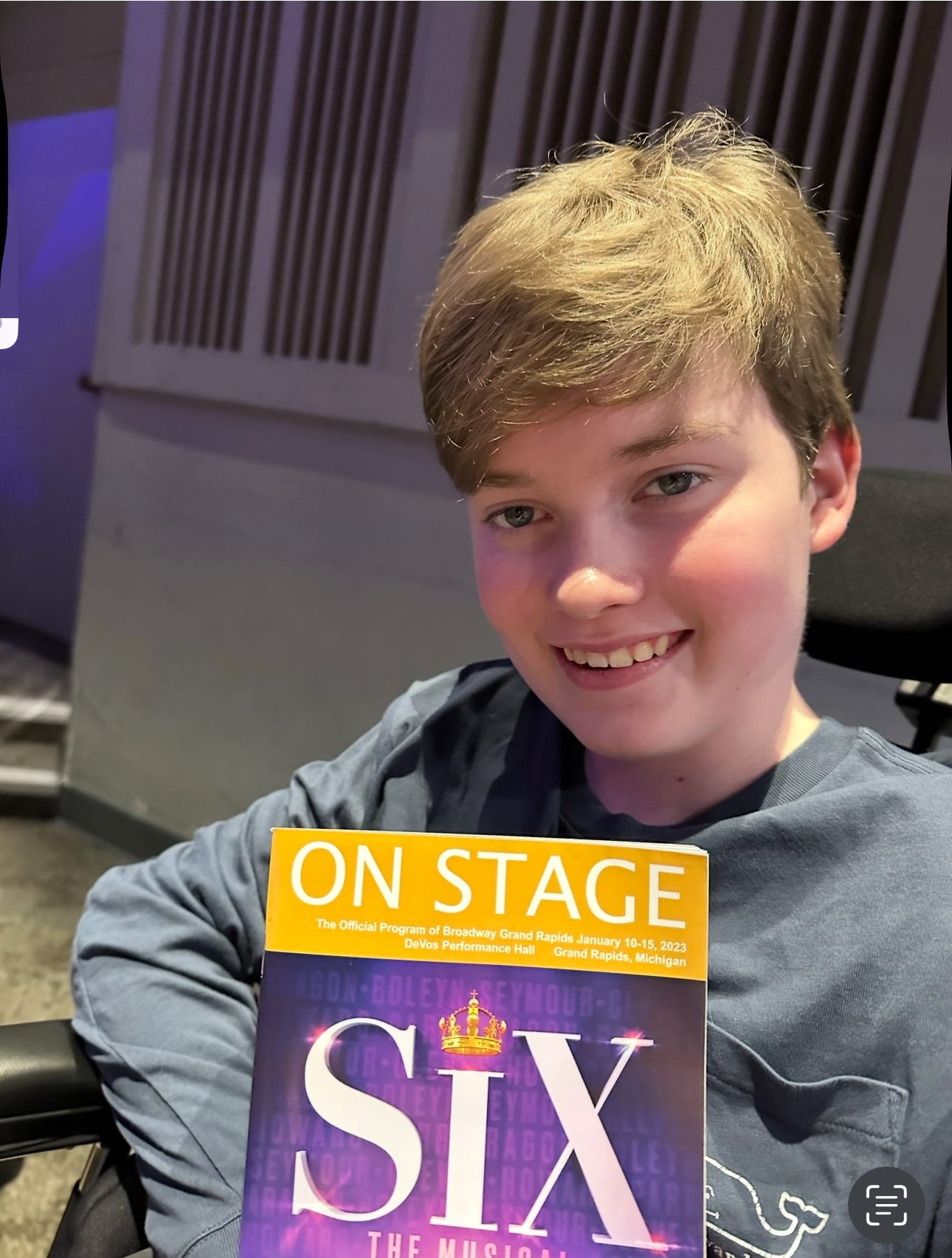
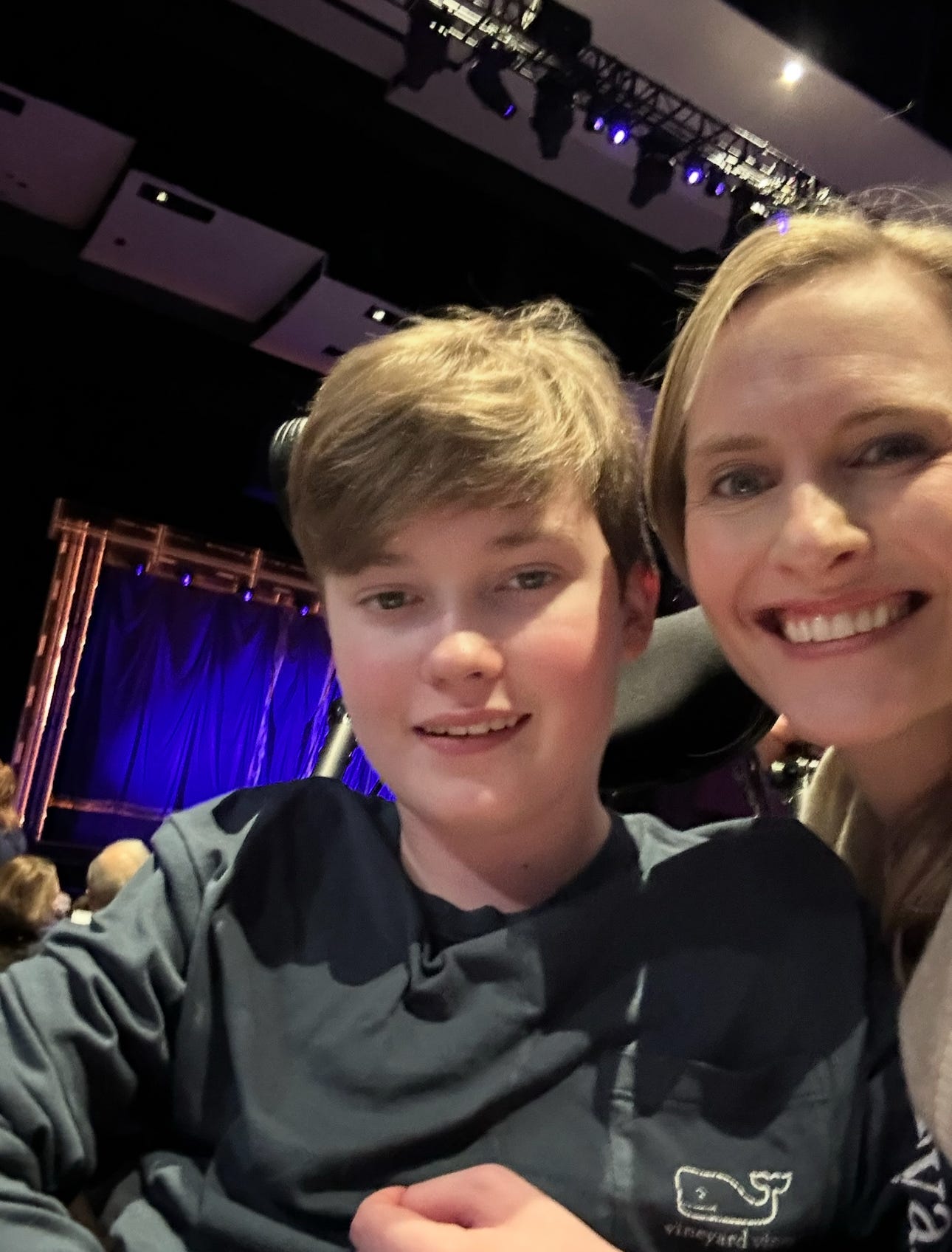
Our first formally accessible tickets we ever purchased were for the musical Six. I called ahead and did everything right. I was so excited to finally be able to do this with my children; it had been a staple of my childhood. For years it had been too complicated to consider. When we arrived, I learned the only thing that made the seats accessible was that the chairs could be moved. They were in the very last row. His chair didn’t fit well. Our view was terrible. Every time the audience leapt to its feet, Brady saw nothing. Guess what? We still had a great time.
And we learned. By the time we saw Mean Girls, Beetlejuice, Wicked, The Lion King and Hamilton, we knew what worked. I learned to read seating charts like battle plans. Security and souvenir lines were often kind to us. They would wave Brady up, let him pick his merch without waiting. Those tiny gestures made up for the hours lost to inaccessible curbs, ramps that were poorly placed or hard to find, and elevators that only worked on alternating Tuesdays. He was not a Broadway fan, but his mom and sisters were, and he was a willing participant.
With each new activity I got more brave in what we could try. Brady’s first real concert required an insane level of logistics. When I went to buy tickets, the only accessible seats were in the back row, behind a wall. To make it worse, the system only let you buy one accessible and one companion seat per transaction. I managed to grab two sets, then found the rest scattered across the arena in different sections, different rows. Not exactly ideal when the entire point of the adventure was to get your 13-year-old daughter to her first concert (thus making up for not buying her $47,000 Eras Tour tickets*.)
*Each. (WHY, TAYLOR?)
The battle plan was intense. I had never been to this arena. I had no idea what would actually work for Brady. I had six regular seats so my daughter could sit together with family friends. We bought two accessible seats for me and Brady in another section, but then found two better accessible seats and grabbed those too. I nabbed four on the floor, just in case the other seats were terrible, and just in case it would allow us to meet up during the concert. I rented a Sprinter van with a driver because Brady was not doing well, and several hours in his uncomfortable carseat would have worn him out before the concert, and I wasn’t sure I could drive several hours while managing his breathing. The van solved all of my problems. This allowed me to hold him on the ride there so he could sleep, stay comfortable and safe, and conserve his energy. Fourteen tickets, four different sections, one sprinter van, and one desperate attempt to let my daughter experience her first concert and still include her brother. I wanted to bring my other daughter too, but despite many phone calls and a ridiculous number of tickets, I couldn’t figure out if we would be able to sit together because of the wheelchair and the two-ticket limitations we had. Some places are flexible and some are not.
In the end, I did not get to sit with my daughter, but we were at least in the same section. Brady got to go. He heard the music. My daughter had the first concert experience she wanted. My other daughter will choose her own first concert. I called that a win.
One special highlight from the night that still makes me smile. People kept bumping Brady’s feet. This was a problem because he had really tender feet. I moved a garbage can in front of his toes, and a moment after I did, an usher came over and grabbed it. I thought I was going to have an altercation when she instead whipped a chair in the garbage can’s place, sat down, turned to me and said, “Not my baby! We will protect those feet!” and personally redirected traffic around Brady and his sensitive tootsies for the rest of the concert. There are some really good people in the world.
There are also some dingbats. We stopped using hotels after this one. It was 2 a.m. on the fourth floor of a Wisconsin resort when the fire alarm went off after a long day of therapy for Brady. I called the front desk to ask if it was real. They weren’t sure, which meant the elevators were out, and we had to evacuate.
That meant packing everything: Brady’s suction machine, food, G-tube supplies, the dog, the girls, the pillows that kept him comfortable. I carried Brady. One daughter carried the equipment, the other had the dog and pillows. We left the wheelchair behind because we were out of hands.
Down four flights of stairs, in pajamas, hearts pounding. We waited in the car until we learned someone had pulled the alarm for fun. At 2 a.m. People. Don’t do that. Don’t be a dingbat.
This past summer, we left Brady’s annual GI appointment and realized we were minutes from the chapel where Michael and I got married. I made everyone go. It was sweltering. We unloaded the chair, the suction machine, the G-tube food, the dog, and the pillows that made Brady comfortable. We walked toward the steeple. Then we discovered… stairs.
I had parked on the wrong side. Our choices were a mile-long detour on footing sweltering heat, or reloading everything and then moving the car and starting over. While I stood debating whether anyone cared enough to keep going, a crew of workers saw us and offered to carry the chair up the stairs. I carried Brady; they carried the chair. We made it. We saw the chapel. We took photos. They carried him back down, told him he was awesome, and gave Max a scratch behind the ears. They were such nice guys. Brady told me later he didn’t really care about seeing the chapel, but he was glad I got to see it again.
Early on in this journey, I made a rule: Brady could try anything he wanted. We would find a way to make it work no matter how tricky it seemed. We would not obsess over accessibility failures because that would just make us angry, and I didn’t want anger to be the soundtrack of anyone’s childhood.
We did try a lot of things. Sometimes I failed on the anger part. Once, a man shook his head in disappointment and waved his finger at me in a grocery store parking lot. He pointed to the handicap sign and glared at me. I had just finished loading up Brady, his supplies, his enormous and heavy wheelchair, bags and bags of groceries and Max; he had missed that part. I did not respond well to his judgmental finger wagging. I was tired and overwhelmed. I wish I could go back and handle that moment better.
We once hiked Lake Michigan dunes with the wheelchair. We made it almost to the lake before we could not get the chair any further in increasingly deep sand. I carried him the rest of the way. The chair was thankfully there when we got back to the wooded path.
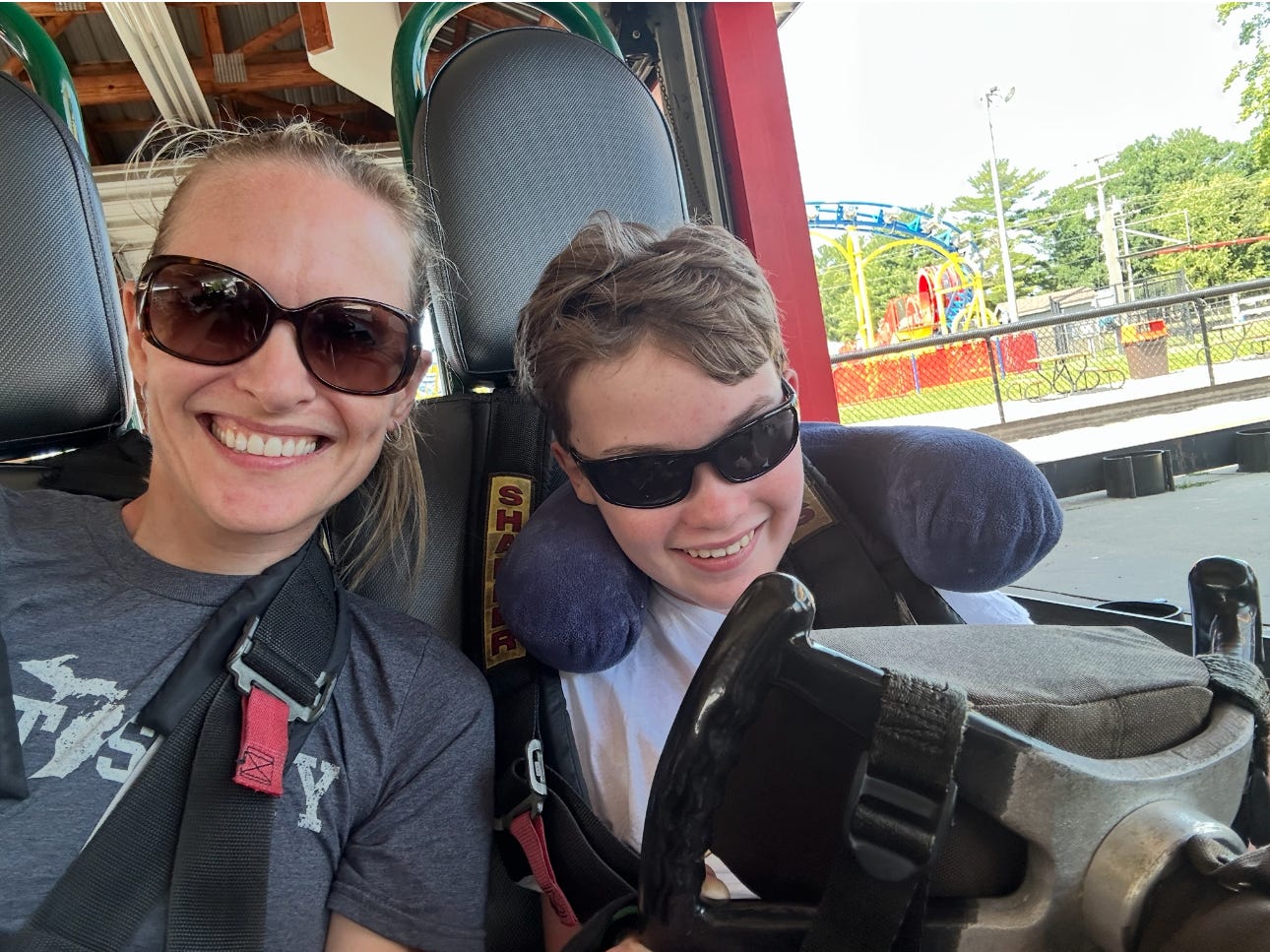
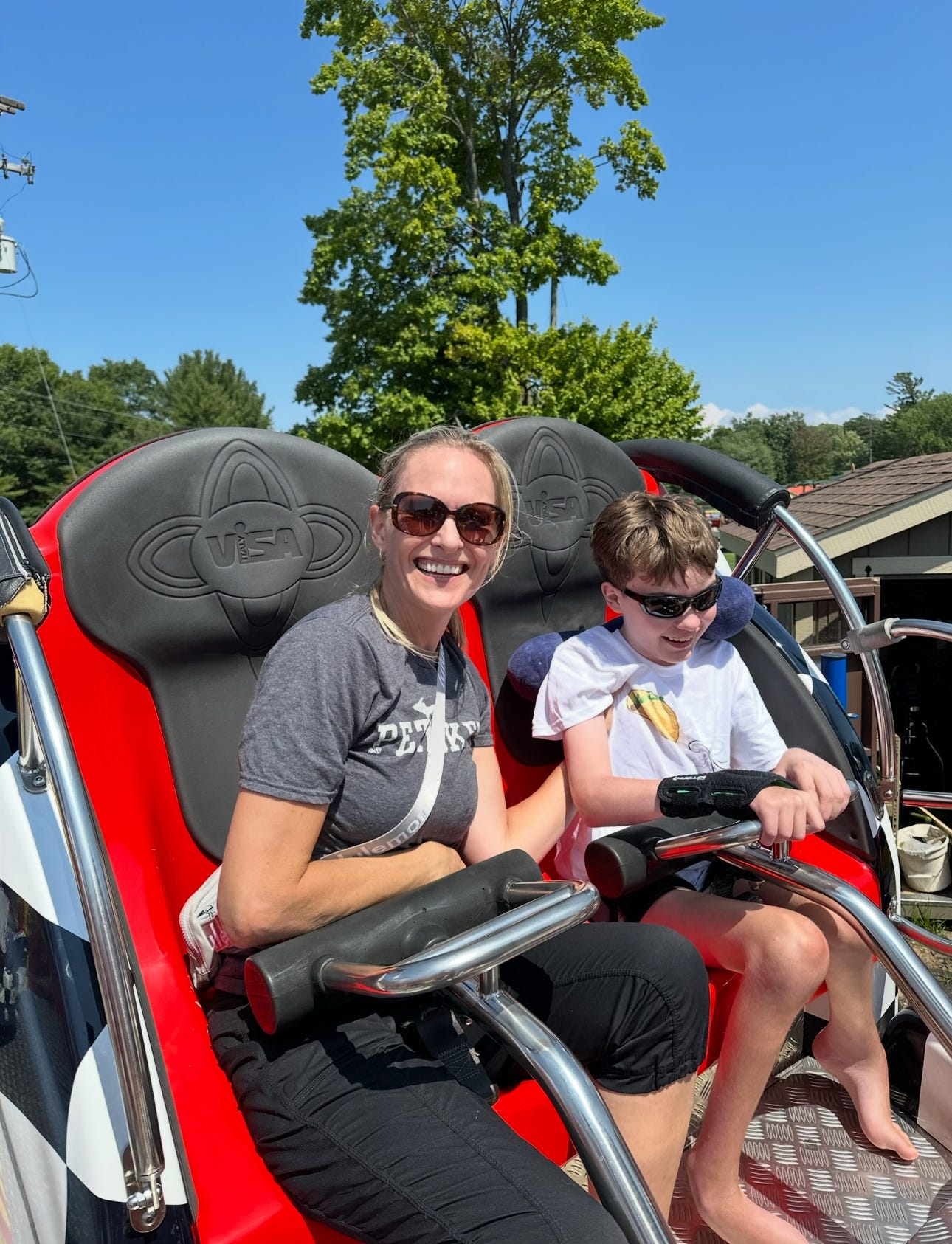
Once, at a little amusement park, a manager worked with me to figure out what Brady could use safely. We settled on go-karts and the roller coaster. I vetoed the demon drop, because of his lack of neck control, but everything else was fair game. Brady was furious about that one omission for hours, but we enjoyed everything else. Especially the roller coaster.
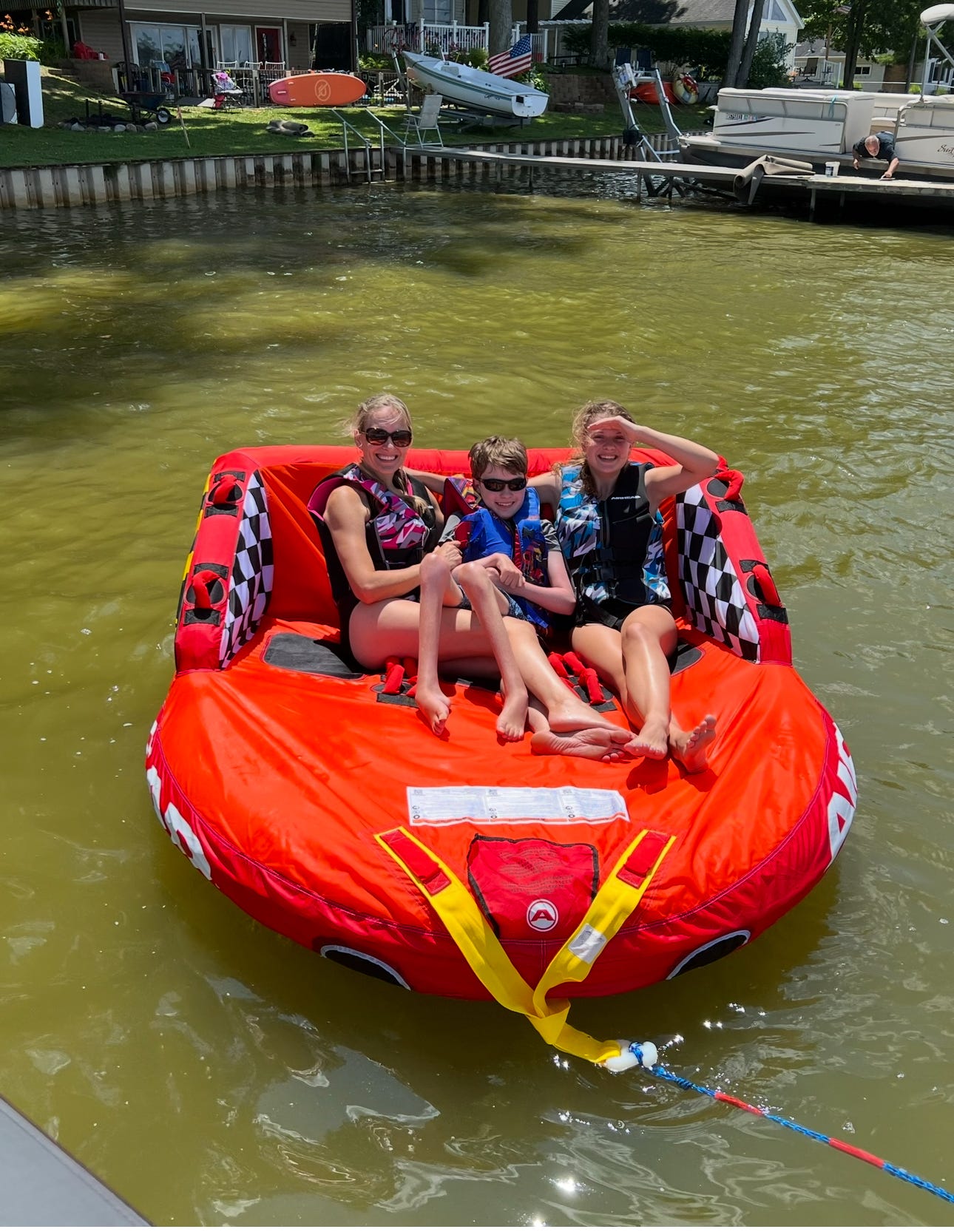
We visited a friend’s cottage that same summer. They surprised Brady with a float that would work for him so he could go tubing. I assumed we would take a mild little run around the lake. No, said the dad, he’s a teenage boy and he needs to go tubing, real tubing! We were yanked around the lake, flew over waves, bounced all around. Brady was elated. The tube had a wide bottom that allowed me to ride with him on one side, a sister on the other, and walls that kept us tucked in. He was so happy.
Those were the moments that kept me sane. They reminded me that joy could exist even in systems and traditions that weren’t built for us.
A year ago, I attended one of Eden’s volleyball games. We couldn’t find the elevator, so we flagged down the principal, who led us on what felt like a seventeen-mile detour around the school. When we finally got there, he pushed the button. Nothing. The maintenance man came. Still nothing. We were missing the game. So the principal and maintenance man carried Brady’s chair up the stairs. I carried Brady. Another teacher had Max. They got us seated. We were sweaty and late, but we made it, everyone was kind, and we were all laughing at the ridiculousness of it all. Last week, I went back to that same gym. One year later. One child short. The elevator was still broken. Everyone was still kind.
Brady has now been gone four weeks, and I still can’t get used to being able to simply grab my purse and walk out the door when we leave the house. Can I tell you this? It was so much work just to leave the house. I usually allowed two hours of getting ready when we had to leave for something. I used to wonder what casually leaving the house would feel like. I have that freedom now. It does not feel good. I miss my son.
I will probably never stop noticing how businesses and organizations treat accessibility; how it is way too often an afterthought, a checkbox, a half-hearted “we tried.” But Brady was my greatest teacher. He showed me that accessibility isn’t just ramps and rails. It’s imagination. It’s the woman who directs traffic around your feet at a concert. The principals and construction workers carrying wheelchairs, friends buying an overpriced floatie and whipping your kid around a lake at full speed instead of taking it slow.
So here’s my advice, from one mother who spent years pushing a wheelchair through a world that wasn’t built for wheelchairs:
Hold the door. Offer to carry the chair. Wave them to the front of the line. Don’t make snap judgements about people in handicap parking spots. Buy the floatie. If your elevator is broken, please fix it. And don’t pull fire alarms at 2 a.m.
You're such a good mom.
All the feels. ❤️💔❤️ My husband has been wheelchair bound because of heart issues and I have needed a wheelchair after surgery to remove my eye. As this post so eloquently describes, Disability brings out the best and worst in ourselves and others. And sometimes the judgment becomes internalized. An older friend broke her hip and was incapacitated. Still, she would not park in the handicapped spot despite having a pass. Her brother, who died very young, had been a quadriplegic and her mom had spent his childhood dealing with the lack of accessibility. So when she — his sister — really needed it for herself and her companions (her hip, her friend who was in her 70s inability to walk, and another friend who had cancer), she just couldn’t bring herself to take the space. Most of us don’t realize how all the ADA compliance stuff is not being adhered to unless we’re in a situation where we or someone we love needs access. Thank you for this beautiful post.